
Monongalia County Directory Collections
Published research documents Morgantown printed volumes across 1901 through 1982. That span identifies years used in historic-building work, not a promise that every annual volume survives at one desk. Start with local catalogs and ask staff to confirm the needed year, format, and retrieval time. The Aull Center is the public library system's local-history branch. WVU's West Virginia & Regional History Center, or WVRHC, holds public records, maps, newspapers, and municipal archives that can support an archival find.
| Collection | Years | Where Held | Access |
|---|---|---|---|
| Morgantown printed volumes | 1901-1982 | Aull Center and WVRHC research channels | Confirm individual volumes with staff |
| West Virginia city and business directories | 1839-1929 database scope | William & Mary Libraries description | Online database information; access terms vary |
| Reverse or criss-cross volumes | Complete run not verified | Aull Center or WVRHC inquiry | Ask about the exact year |
| Newspapers and census material | Newspapers 1791-present; census 1810-1930 | WVRHC collections | Digital, microfilm, and reading-room routes |
No authoritative source confirmed a complete Monongalia County reverse-directory or telephone-book run. A sound search therefore uses the Aull Center and WVRHC collections desk as fallback channels instead of assuming a searchable database exists. Ask about the exact year and format.
The West Virginia city and business directories collection description documents the broader digital range used to plan a search.
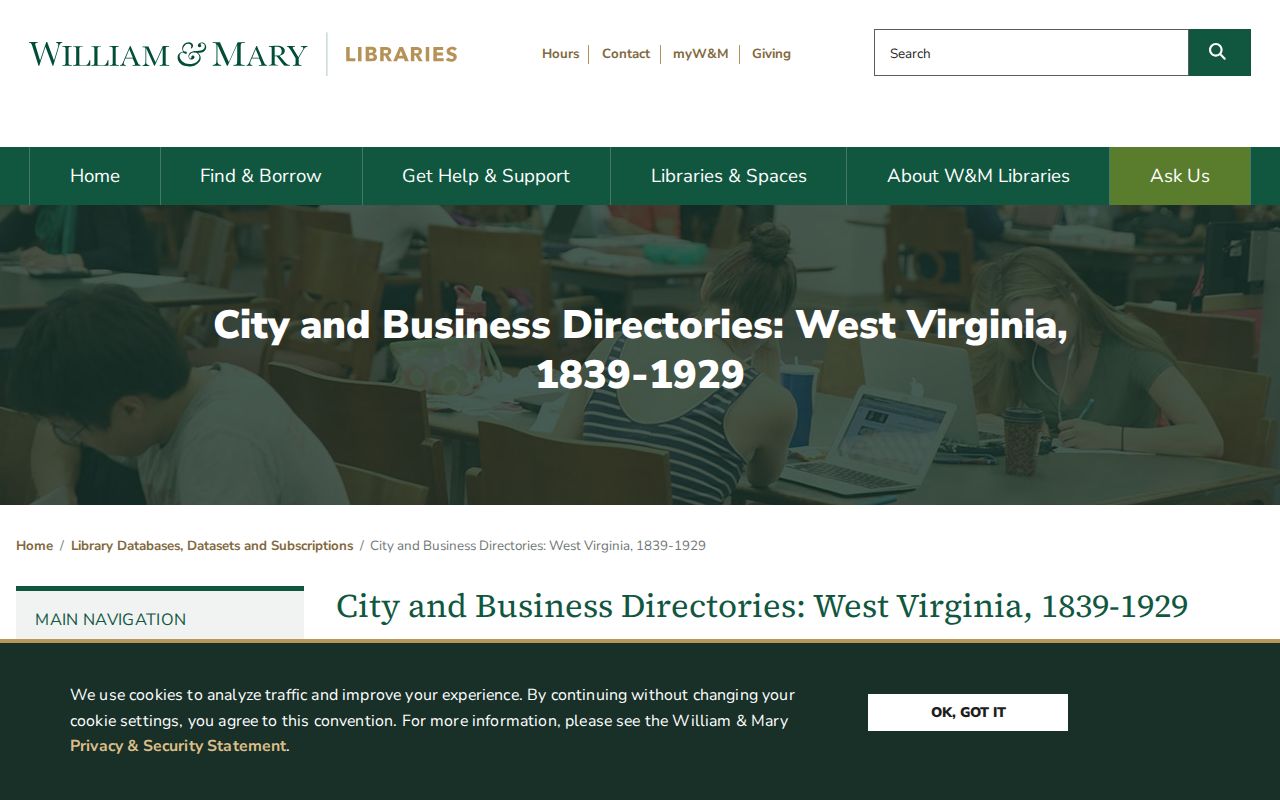
The collection screen is a starting point, not proof that every Monongalia County year survives or is available online.
Monongalia County Directory Research Desk
The Aull Center sits at 351 Spruce Street in Morgantown and focuses on local history and genealogy. Its published hours are Monday and Tuesday from 9 a.m. to 6 p.m., Wednesday through Friday from 9 a.m. to 4 p.m., and Saturday from 9 a.m. to 1 p.m. Call 304-292-0140 before a special trip. That check can establish whether a printed volume, yearbook, newspaper resource, or local item is ready for use.
The main Morgantown Public Library at 373 Spruce Street has a separate service desk and schedule. Aull Center access includes Newspaper Archive for West Virginia papers from 1800 forward and Ancestry Library Edition at the library. These are library-controlled services, so remote personal access should not be assumed. Ask staff about copying rules and record the volume title, year, page, and entry exactly.
Reading Monongalia County Directory Entries
WVU's Greenmont research shows the basic alphabetical entry: a resident name, address, and occupation. A volume may also use initials, spouse references, status words, or household and business marks. Conventions change between publishers and years. Read the abbreviation key in the same book before expanding any code, and avoid adding details the printed line does not state.
| Resident name | Surname with a given name or initials; spelling can vary by year. |
|---|---|
| Address | A numbered street address, apartment, rear unit, business, or institution. |
| Occupation or status | A trade, role, employer, or status as printed in that edition. |
| Household clue | A spouse reference, boarder, widow notation, or relationship clue when supplied. |
- Criss-cross directory
- A directory arranged by street or telephone number rather than only by surname.
- Householder index
- An address-led list of the named person associated with a household.
- Abbreviation key
- The publisher's legend for shortened words and marks used in that volume.
Greenmont City Directory Evidence
A WVU Libraries account of the Pietro brothers in Greenmont gives Monongalia County a concrete research model. It pairs city directory entries with Sanborn fire-insurance maps and historic-building sources. The entry supplies a name, street address, and occupation. The map tests whether the building footprint and nearby streets fit that address at the same time.
The WVU Greenmont research example was captured successfully.
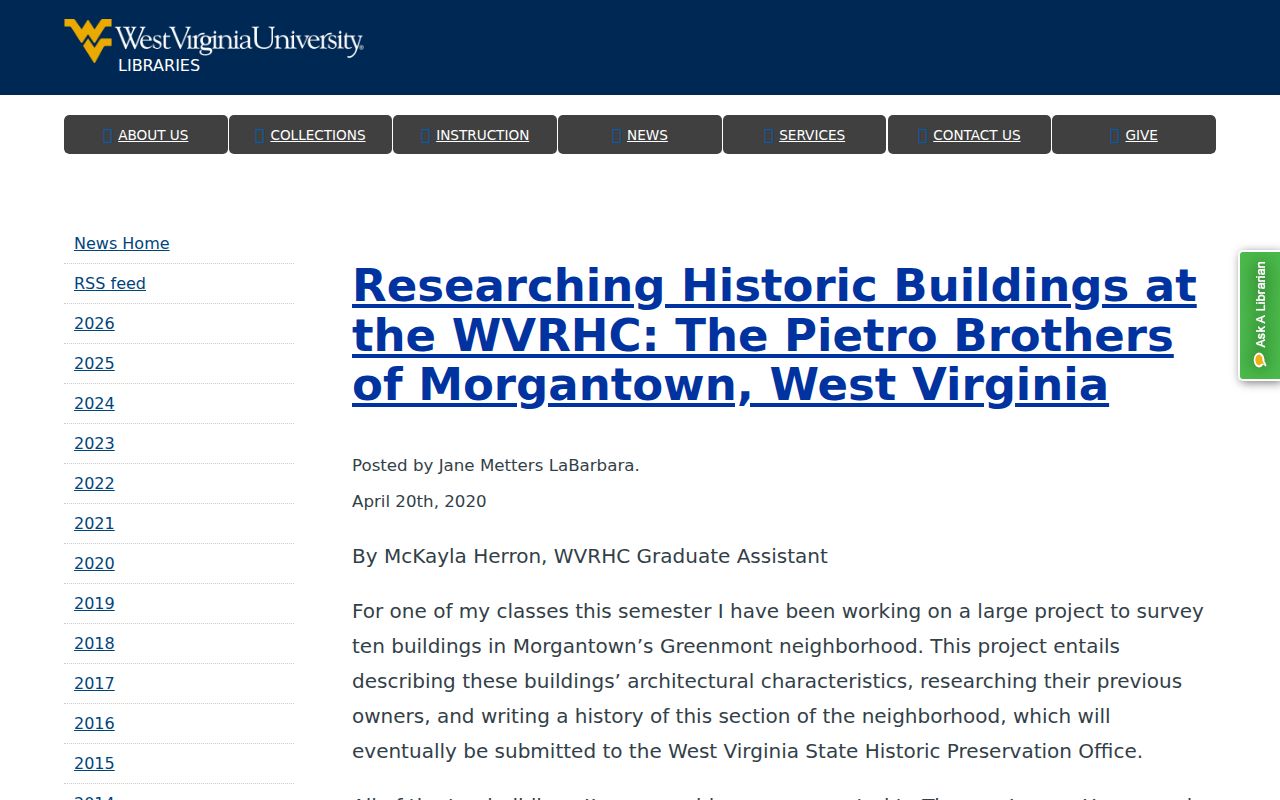
The capture points back to the university's method, which treats a directory line as dated evidence and checks it against the physical history of the place.
Map Monongalia County Directory Addresses
Sanborn maps help when an address has changed or a building no longer stands. The Library of Congress has a six-sheet Morgantown map dated March 1899. Other documented map years include 1904, 1906, 1911, 1921, and 1927. WVU's 1921 material also includes Granville, Riverside, Star City, Sturgiss City, and Westover.
Compare the street name, cross street, building shape, construction details, and nearby landmark. The map does not name every resident, so it cannot replace a city directory, deed, census line, or newspaper item. No official date for a broad Morgantown street renumbering was found. When old and new numbers conflict, preserve both forms and use the intersection, deed description, and adjacent properties as stable checks.
Monongalia County Yearbook Clues
A directory often lists adults tied to work or a household, while a yearbook can identify a student, club, team, or school-era peer. The Aull Center reported holdings from elementary schools through WVU, including Morgantown High School 1965 and Sabraton Junior High 1975. Those examples are useful leads, not proof that a person remained in Monongalia County later.
Search the yearbook name and activity, then return to city directories for the family address around that year. Newspapers can test graduation notices, clubs, churches, moves, marriages, and obituaries. Cite the yearbook title, school, year, and page. For newspapers, save the paper title, issue date, and page so another researcher can repeat the search.
Morgantown Records Fill Directory Gaps
Morgantown Municipal Records A&M 3304 at WVRHC provide 61 microfilm reels and a long civic trail. The finding aid lists council journals for 1838-2013, ordinance books for 1905-2013, resolution books for 1990-2013, election records for 1979-2013, and deed books for 1916-2013. The deed books can include contracts, leases, and agreements. Other files cover utilities and sidewalks.
These records can explain why an address changed, why a street gained a utility, or how a project affected a block. They do not establish that a named person still lives there. WVRHC is at 1549 University Avenue in Morgantown, and staff can be reached at 304-293-3536. Public microfilm and reference resources may be used without an appointment, but archival or offsite items may need advance retrieval.
The Morgantown Municipal Records finding aid was captured successfully.
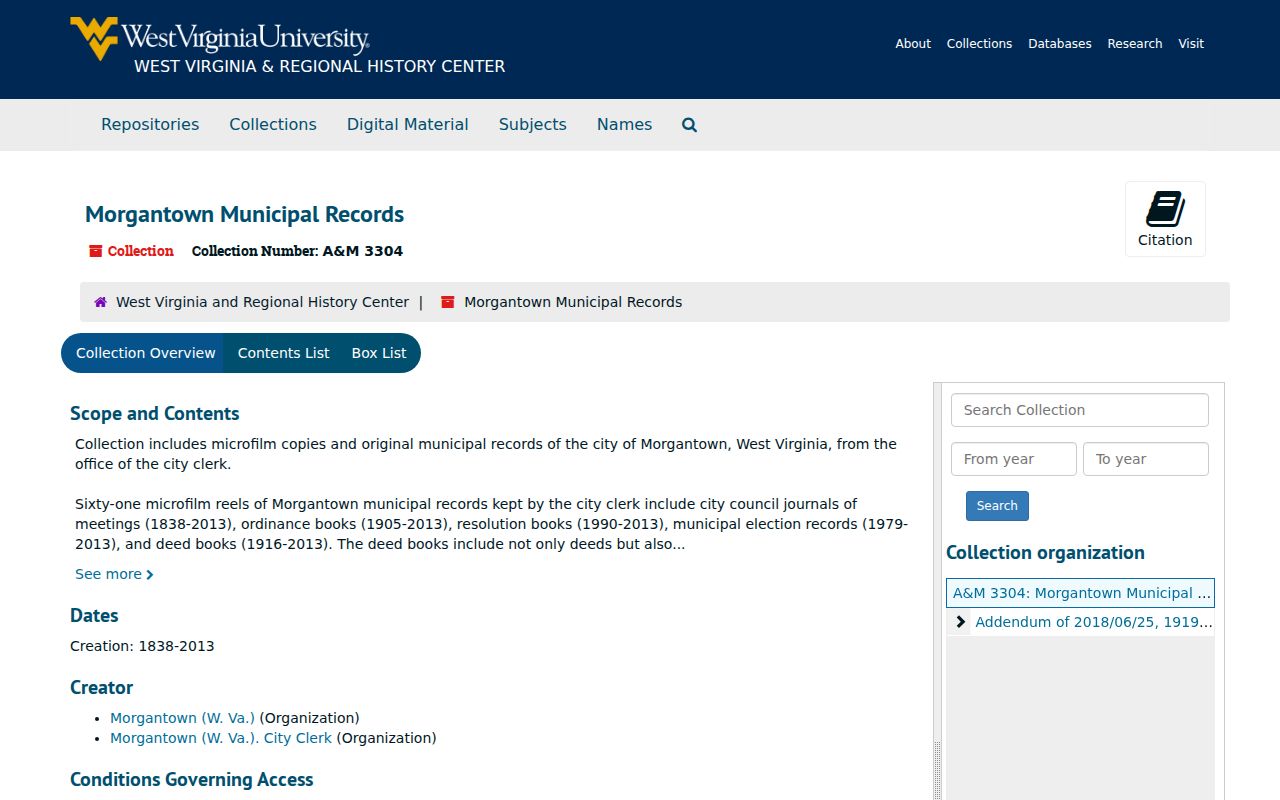
The finding aid shows the collection context needed to request the right reel, series, or box.
Monongalia County Archive Bridge
WVRHC's public-record holdings widen the search before and between printed volumes. The center describes Monongalia County court material, tax sources, deeds, surveys, voter and election records, school reports, naturalizations, roads, vital records, wills, and estate settlements. Census schedules cover 1810 through 1930, with Soundex tools that group similar-sounding surnames. Because the 1790 and 1800 Virginia census schedules were lost, tax enumerations from 1782 through 1785 can sometimes supply an earlier household clue.
The West Virginia State Archives adds microfilm depth. Its Monongalia inventory lists deed indexes for 1776-1935, deeds for 1789-1900, surveys for 1781-1862, and estate records for 1824-1927. Those dates do not mean every person appears. They show where to continue when a surname predates the Morgantown directory run or when an entry points to an owner, estate, or parcel.
At WVRHC, note the collection title, series, box or reel, and page or image number. A yellow call slip is used for reading-room requests. Microfilm and reference material can be available without an appointment, while offsite archival records may require staff retrieval. The Monongalia Historical Records Survey is a practical starting point for reel-level planning.
Confirm Monongalia County Directory Finds
Newspapers turn a bare entry into a testable timeline. Search the surname with the exact street, then try terms tied to moves, sales, estates, marriages, churches, schools, clubs, and local business. A legal notice carries a different weight from a social mention or advertisement. Save the issue date and page, and quote only enough to identify the event.
County deeds can confirm a transfer, but a deed does not prove who occupied the home. Census schedules can show a household, yet early schedules may require a district and neighbor sequence rather than a street number. Yearbooks can identify school-era names. Each source answers a different question, and agreement across two or three dated sources is more useful than one untested match.
Trace Monongalia County Families
Follow a household across years with a written log. Each line should hold the source date, exact spelling, exact address, evidence type, and next check. The directory publication date is only a snapshot. It does not prove a move-in date, move-out date, or ownership.
- Find the earliest useful surname entry and copy the full line plus its abbreviation key.
- Check the next available volume in both directions, noting initials, spouses, occupations, and address forms.
- Pair directory years with WVRHC census schedules and Soundex tools, especially the 1810-1930 holdings.
- Test the address against a Sanborn sheet, deed index, tax source, and dated newspaper notice.
- If the name vanishes, check probate, obituaries, marriage records, and later directories before deciding why.
Disappearance can mean death, a move, omission, a spelling change, or a shift to another household. A renter or boarder may never appear in the deed chain. For a modern address route, use the Monongalia County street directory and keep the historical shelf focused on dated evidence.