
Finding Monongalia County Residents
Choose the first record by what is known. An address points to the county assessor and statewide parcel map. A current or former owner's name belongs in the County Clerk's electronic index. A party to a civil or criminal case may appear in a state court portal. An older name can be checked in city directories, census schedules, newspapers, wills, and the West Virginia & Regional History Center. This layered method makes the Monongalia County residents directory useful without pretending that one master list exists.
Ownership is not the same as occupancy. The assessor normally names the owner of record, not each adult at the property. Voter records omit people who are not registered and protect certain fields. Old directories may skip rural areas, students, renters, or people who declined a listing. Match at least two facts, such as a middle initial and street, before deciding that records refer to one person.
- Search the assessor by owner, street, district, map, or parcel.
- Check the official West Virginia voter-status tool for the person.
- Search County Clerk indexes for deeds, liens, estates, and vital entries.
- Use court party searches, then confirm the record with the clerk.
- For an earlier era, consult directories, census records, and archival collections.
Monongalia County Directory Offices
Three courthouse functions form the core local trail. The County Clerk records deeds and liens, administers elections, handles probate, and supplies county birth, death, and marriage certificates under access rules. The Assessor maintains parcel and map-card facts used for taxation. State court systems publish party indexes, but certified or complete copies come from the clerk of the court that holds the case. These records answer different questions, so the office named on the record remains the final source.
Monongalia County Clerk
243 High Street, Room 123
Morgantown, WV 26505-5491
304-291-7230
Searching Monongalia Parcel Records
The Monongalia County parcel database accepts more than a simple address. Search choices include owner, street, district, map and parcel numbers, sale details, deed type, acreage, and current or historical controls. Partial-name searching helps when initials or spelling vary. The assessor cautions that transfers can lag and that a capped result list may require a narrower query. A parcel is a tax-mapped unit, while a situs address is the physical location used for that parcel.
| Search field | Best use |
|---|---|
| Owner | Find property tied to a known name |
| Street | Compare parcels along one road |
| District | Narrow repeated names or road names |
| Map and parcel | Open a known tax-map record |
| Current/history | Separate present and prior assessment data |
The statewide assessment search adds prior-owner and advanced fields. Its results and CSV export can help compare a group of parcels, but neither assessor source proves who sleeps at an address today.
Monongalia Deeds Name the Parties
The County Clerk index links names to recorded instruments, including deeds and liens. In a deed search, the grantor is the person conveying an interest and the grantee is the person receiving it. Search by both roles when tracing a resident, because the same person may appear on opposite sides of later transactions. Date limits and document types reduce false matches.
The index is a finding aid. An image shows more context, and a certified copy comes from the custodian. The clerk's electronic search help explains index, image, vault, browser, and payment functions. When an image is absent, call, mail, or visit the courthouse during weekday office hours rather than assuming the instrument does not exist.
The official Monongalia County records search can be previewed below. Its filters make a name more useful when paired with a date or document type.
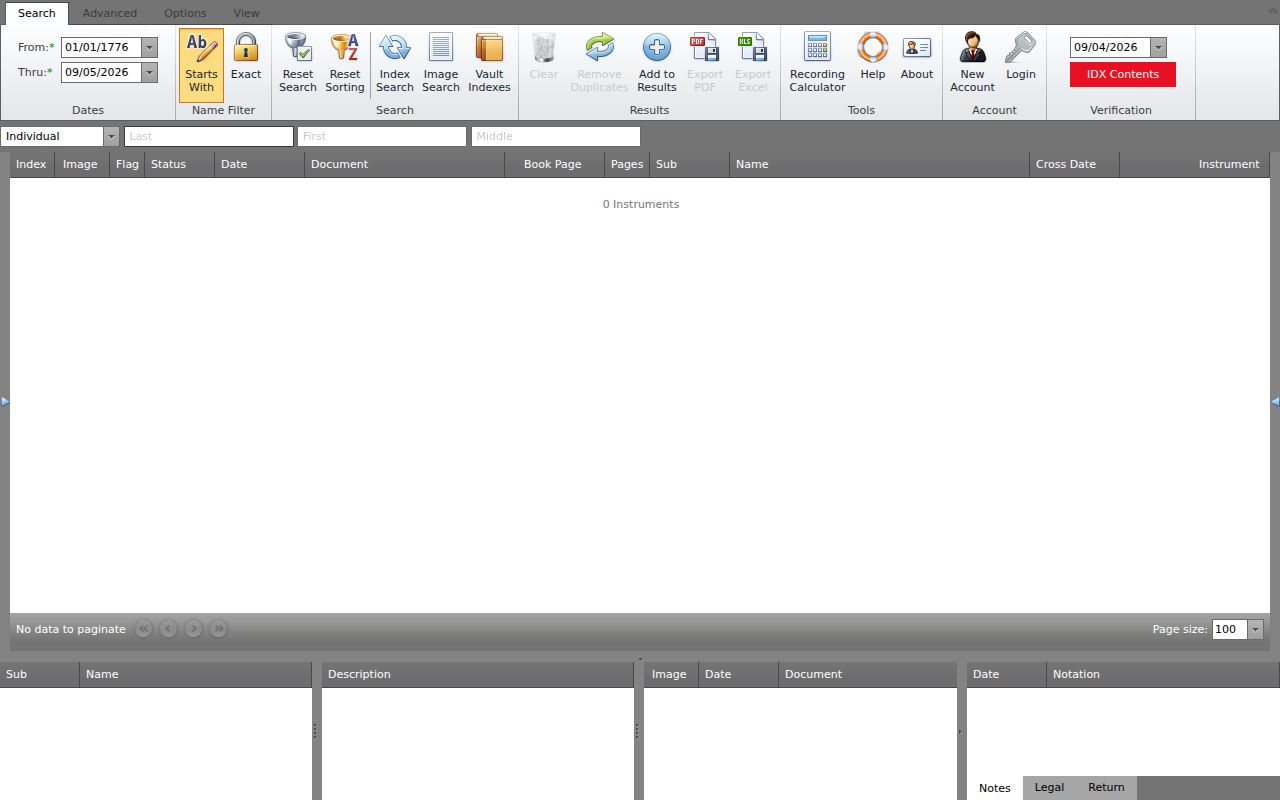
The captured index screen shows why the county source should be checked before relying on a broad directory result.
West Virginia Voter Record Limits
West Virginia law permits inspection of specified voter-registration fields, but it does not turn the roll into an unrestricted household list. Under W. Va. Code §3-2-30, protected identifiers include phone numbers, email addresses, Social Security numbers, and driver's-license numbers. The law also restricts commercial and solicitation uses. The official voter-status lookup is the right starting point for checking one's registration.
For broader election information, the County Clerk elections office is the custodian. Requests for public fields can also proceed through the office and the state's lawful inspection process. A voter entry is one dated source, not proof that every member of a home is registered or still present.
Use records lawfully. Public information may support family, property, and civic research, but it must never be used to track, threaten, or harass a person.
Current Monongalia Resident Directory Sources
Modern directory work depends on purpose-built rolls. The sources below differ in who they cover, how current they are, and what the public may see. That difference is useful. Agreement between a parcel owner, a recorded deed, and a court or probate entry is stronger than a lone name returned by a general search.
| Source | Who It Lists | Keeper | Access |
|---|---|---|---|
| Property roll | Taxed parcel owners | County Assessor | Free portal and office |
| Voter status and roll | Registered voters | Secretary of State and County Clerk | Lookup or lawful request |
| Recorded-document index | Parties to deeds, liens, and estates | County Clerk | Online index and courthouse |
| Court party index | Named case parties | West Virginia judiciary | Portal, library, or clerk |
| Neighborhood associations | Civic groups and contacts | City of Morgantown | Public association list |
Use the property and deed sources for ownership, the voter channel for registration, and the court portal for a case connection. Community associations show public contacts, not private membership rolls. For a name-first verification process, continue with the Monongalia County resident lookup.
Monongalia Court Party Searches
The West Virginia judiciary divides public online access by court level. WVPASS is the statewide circuit-court portal. The Magistrate Case Search covers magistrate matters and uses a disclaimer, county selection, and CAPTCHA. The judiciary says the magistrate tool may be used from a computer, mobile device, or library. Search results should be confirmed with the appropriate clerk because online entries may not reflect every filing or later change.
The Monongalia court information page identifies the Circuit and Family Court contacts. For a missing document or unclear disposition, ask that office about inspection and copies. A docket is the chronological list of case events; a disposition describes the result or status. Neither should be read as a current address directory.
Search with care when names repeat. Add a middle initial, case type, filing period, or known county only when the portal supports it. A person can appear as a plaintiff, defendant, witness, creditor, attorney, or representative, and those roles do not establish where that person lives. Sealed, expunged, juvenile, or otherwise protected matters will not form part of a public residents directory. If a result matters to family or estate research, record the case number and ask the clerk which public documents can be inspected at the office or supplied by request.
Monongalia Vital Record Routes
The County Clerk holds county birth and death records from 1853 forward and marriage records from 1795 forward. The state Vital Registration office provides the statewide repository and certificate route. Requests can be made through documented mail, in-person, and online channels, depending on the certificate. Forms ask for identity, relationship or reason, contact details, and the required fee.
These are not open resident rolls. West Virginia treats births as confidential until 100 years have passed. Death, fetal-death, marriage, and divorce records remain confidential for 50 years, subject to W. Va. Code chapter 16, article 5 and statutory exceptions. Genealogists can also check selected searchable historical indexes through the West Virginia Vital Research Records Project.
Note: A certified copy is an official copy issued by the custodian, while an index entry only points to the underlying record.
When Monongalia Portals Fall Short
An empty web result is not the end of a Monongalia County residents directory search. Older books may not be digitized, names may be indexed under a variant, and a recent transfer may not yet appear in the assessment system. Try a partial surname, widen the date range, switch grantor and grantee roles, and search a street without its suffix. Then use the office counter, telephone, mail request, or archival reading room documented for the record set.
The West Virginia Freedom of Information Act supplies a request route for nonexempt public records held by a public body. A request should identify the record with reasonable detail. The statute provides a five-day response framework and permits reasonable reproduction fees. Exemptions, including privacy and law-enforcement limits, remain in W. Va. Code §29B-1-4.
Official Rolls Beat Broad Claims
Official rolls are narrower than commercial people-finder reports, but their limits are easier to understand. The assessor answers a parcel question. The clerk answers a recording question. The judiciary answers a case-index question. A commercial report may blend old and current data without showing when a source changed. It may also join two people who share a name.
| Source type | Strength | Main limit |
|---|---|---|
| Custodian portal | Defined public record and keeper | Covers only that record system |
| Office or archive | Copies, staff help, older material | May require a visit or request |
| Commercial compilation | Fast lead across mixed sources | Age, source, and identity may be unclear |
Use a broad result only as a lead. Return to the named custodian to test it. That step matters most for common surnames, people who moved, and addresses that changed format.
Monongalia Records Vocabulary
A few terms appear throughout county and archive searches. Knowing their narrow meaning prevents a useful lead from becoming a false claim.
- Roll
- A list maintained for one public function, such as assessment or voter registration.
- Index
- A searchable pointer to a recorded document, certificate, or case.
- Parcel
- A tax-mapped unit identified by district, map, and parcel numbers.
- Criss-cross directory
- A directory arranged by address or telephone rather than only by surname.
- Certified copy
- A copy authenticated by the government office that holds the record.
Each term marks a boundary. A parcel result is not a survey, an index is not the full instrument, and a roll made for one public task is never a full census of Monongalia County residents.
Protected Monongalia Resident Addresses
Some residents have strong legal reasons not to appear at a physical address. West Virginia's Address Confidentiality Program offers a substitute-address system to qualifying survivors of domestic violence, sexual assault, stalking, or trafficking. The program operates under W. Va. Code §48-28A and includes mail forwarding and participant duties.
A substitute address must not be treated as a person's actual home. Public portals also withhold other protected identifiers. These safeguards explain why responsible searches sometimes stop at an office contact, a dated record, or a general locality. Absence from a public directory is not evidence that a resident is hiding anything.
Historical Monongalia Resident Directories
The historical trail extends well beyond today's portals. The West Virginia & Regional History Center preserves county court, census, tax, deed, voter, vital, will, road, school, and naturalization material. Its Monongalia Historical Records Survey reels include land, cemetery, estate, order-book, birth, and death sources. The West Virginia State Archives microfilm inventory provides another route to deed indexes, surveys, marriages, wills, courts, and bonds.
Morgantown city directories add household-level context. Entries may give a resident's name, occupation, spouse, and street address, while later criss-cross arrangements help search by address. Researchers can pair a directory year with census schedules, newspapers, and Sanborn fire-insurance maps. The Aull Center also offers local-history and genealogy access. The full collections and reading method are detailed on the Monongalia County city directories page.
Access is split between digital descriptions and reading-room material. Search the online collection guide first, note a collection or reel identifier, then contact the repository about access and staff help. At the Aull Center, newspaper and genealogy resources can fill gaps between directory years. At the regional history center, municipal papers spanning council, ordinance, election, deed, utility, and related files can explain why an address or street use changed. This is often more productive than repeating the same name in a modern search box.
Morgantown Buildings Reveal Residents
A West Virginia University Libraries study of Morgantown's Pietro brothers shows how local records become more useful when combined. Researchers used city-directory entries keyed by address and occupation with Sanborn maps and building evidence. That pairing can separate a business address from a home, track a change in street use, and explain why a person appears at more than one place.
The WVU historic-building research example is pictured below.
The project demonstrates the central lesson of resident research: a directory becomes more reliable when a map, deed, or dated archival record supports it.